
GM Cassava Nears Release in Kenya as Kinga Kuu Varieties Promise Higher Yields and Disease Resistance
Posted by EDITORIAL
Kenya prepares for the release of Kinga Kuu GM cassava with 8 improved varieties offering higher yields and resistance to devastating diseases, marking a major milestone in agricultural innovation and food security.
In Summary
- Kenya is readying the release of “Kinga Kuu” GM cassava with 8 improved, high-yielding and disease-resistant varieties developed locally.
- Cassava farmers continue to face devastating losses of up to 100% due to persistent viral diseases, underscoring the urgency for innovation.
Previous Read: GM Maize progress in Kenya
Also Read: Seeds of change ( How GMOs & Biotechnology are shaping the future)
Also Read: Wycliffe Oparanya Launches Africas first Bee Venom Marketplace
Cassava has long stood as a quiet pillar of food security in Kenya, particularly in regions where climate variability makes other staples unreliable. Across coastal counties like Kilifi, the crop is deeply embedded in household survival, consumed in various forms from boiled roots to flour, while its leaves provide an important source of nutrition. Beyond subsistence, cassava is increasingly recognized for its industrial value, with its starch used in food processing, adhesives, textiles, pharmaceuticals, and even manufacturing inputs such as paper and carpets. Despite this wide-ranging utility, cassava has not fully realized its economic potential in Kenya, largely due to persistent production challenges that continue to undermine farmer confidence.

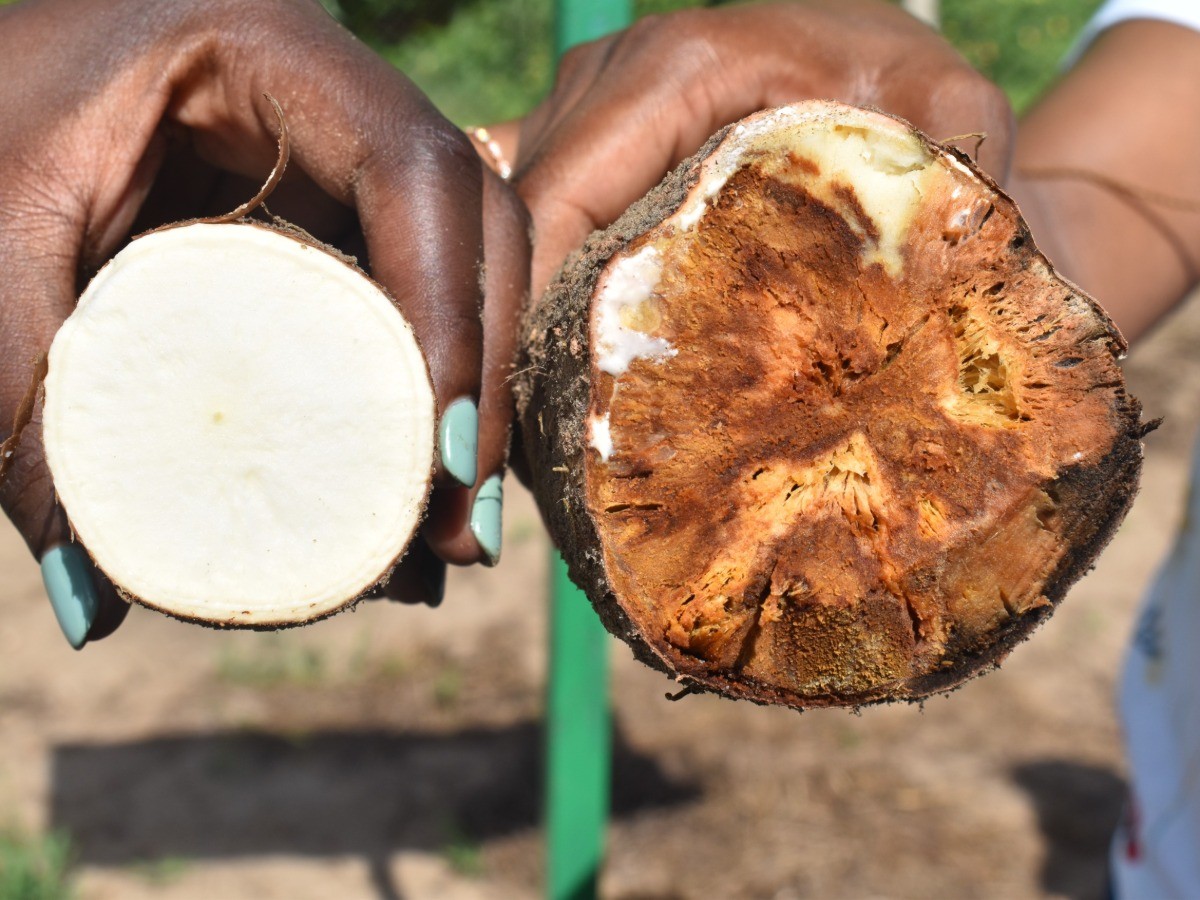
Cassava thats stricken with cassava mosaic & Cassava brown Streak disease
Chief among these challenges are cassava brown streak disease and cassava mosaic disease, two viral threats that have severely constrained yields across the country. These diseases are spread both by insect vectors and through the common farmer practice of sharing infected planting materials, making them difficult to control once established.
"Both the diseases are transmitted by insects & farmers can also disseminate the disease through sharing of cuttings"
said Dr paul kuria Research scientist kalro
"Mostly it is seen through symptoms and reduced vigor of the plants."
The impact is often devastating, as farmers may tend to their crops for up to a year only to discover at harvest that the roots are rotten and unusable. In many cases, this results in complete crop failure, with some farmers reporting losses of up to 100 percent. This cycle of uncertainty has steadily eroded cassava’s profitability, pushing many farmers to reconsider its viability despite its resilience as a crop.
It is within this context that Kenya’s scientific community has spent over a decade developing a solution in the form of the Kinga Kuu genetically modified cassava. The product of more than 12 years of research led by Kenyan scientists in collaboration with regional and international partners, Kinga Kuu represents one of the most advanced cassava biotechnology initiatives globally. The project has focused on addressing the most critical farmer concerns by developing cassava varieties that are resistant to both cassava brown streak disease and cassava mosaic disease, while also improving yield, reducing cyanide content, and enhancing overall crop quality. Through this process, researchers have successfully developed eight distinct varieties tailored to different agro-ecological zones across the country.
"Kinga Kuu varieties have demonstrated very high resistance to cassava mosaic and brown streak disease through conventional breeding and modern biotechnology."
said Dr paul kuria Research scientist kalro
Field demonstrations in Mtwapa reveal a striking contrast between conventional cassava and the improved Kinga Kuu varieties. The new cassava produces larger, healthier roots and demonstrates strong resistance to the diseases that have long plagued farmers. In terms of productivity, the difference is equally significant. While traditional cassava typically yields between 5 to 7 kilograms per plant, the improved varieties are delivering approximately 8 kilograms per plant, representing a yield increase of over 10 percent. More importantly, the built-in disease resistance ensures that farmers can reliably harvest what they plant, eliminating the risk of total loss that has defined cassava farming for years.
Also Read: Africa's Food Future in Innovation
Kenya has now reached a critical regulatory milestone in the journey toward making this innovation available to farmers. The National Biosafety Authority has granted approval for environmental release, allowing the cassava to proceed to national performance trials, a key step in the regulatory pipeline. These trials have largely been completed, and the focus now shifts to the final stages awaiting release. Officials involved in the process indicate that, pending final approvals, the Kinga Kuu cassava could be released to farmers as early as the next planting season. Throughout this process, regulators have maintained a strict oversight framework to ensure that all genetically modified crops meet safety standards for human consumption, environmental protection, and economic benefit.
Beyond food security, the introduction of improved cassava varieties carries significant implications for Kenya’s industrial sector. Cassava starch remains a critical raw material in multiple industries, yet the country continues to rely heavily on imports to meet demand. With higher-yielding and more reliable cassava production, Kenya has the opportunity to localize this value chain, supporting manufacturing, creating jobs, and reducing import dependency.
"This cassava can grow to most region in the country. kenya imports Cassava starch from Egypt that is similar to the GM cassava. See Cassava as a resource creation. " Said Dr Thuo Mathenge Chairman kalro
Researchers emphasize that cassava should no longer be viewed merely as a subsistence crop, but as a strategic resource capable of driving economic transformation when supported by the right technologies and policies.
Equally important is the growing effort to address public perception and build trust around biotechnology. Experts involved in the project stress that the development of genetically modified crops is a highly regulated process involving extensive testing and verification.
"The Kinga Kuu cassava has undergone rigorous evaluation to ensure it is safe for human consumption, animal feed, and the environment. National Biosafety Authority maintain a neutral stance, focusing on providing accurate information so that farmers can make informed decisions about adoption based on their own needs and circumstances."
Said David wamatsi Omusotsi Chairman of National biosafety authority
On the ground in Kilifi, farmer sentiment reflects optimism mixed with urgency. Having witnessed firsthand the performance of the improved cassava varieties, many farmers are eager to access the planting materials, driven by years of frustration with crop losses and low returns. The visible difference in plant health, root size, and resilience has strengthened confidence that this innovation could mark a turning point. For these farmers, the anticipated release of Kinga Kuu is not just another agricultural development, but a long-awaited opportunity to restore productivity, secure incomes, and rebuild trust in cassava as a viable and profitable crop.
Photo credits and Courtesy: KALRO & AATF